

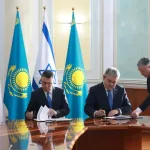
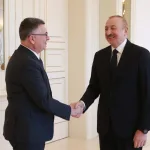




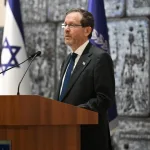




For the first time in years, the Israel-EU Association Council meeting convened in Brussels. Minister of Foreign Affairs Gideon Sa’ar addressed the gathering and told EU foreign ministers: “Our relations should not be held hostage to the bitter conflict with our Palestinian neighbors.”
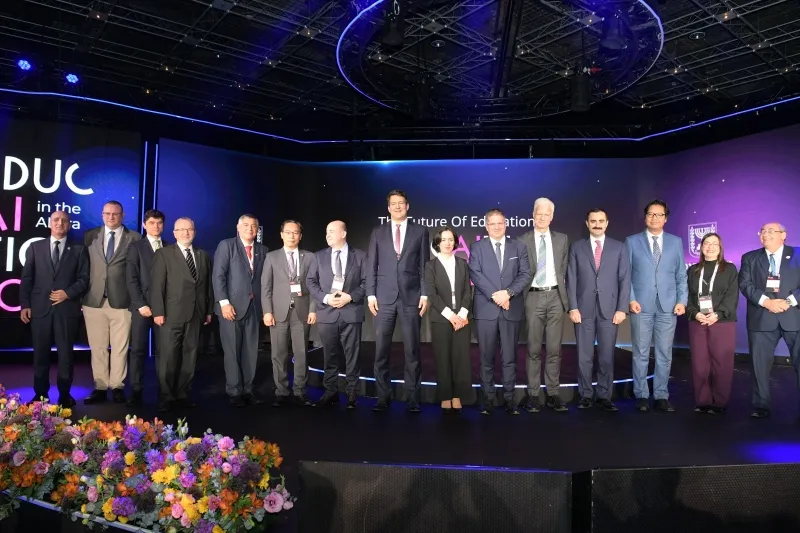
For the first time since 2012, the Israel-EU Association Council meeting – the high-level forum for the management of Israel-EU Relations – was held in Brussels, with the participation of the High Representative of the European Union for Foreign Affairs and Security Policy Kaja Kallas, Minister of Foreign Affairs Gideon Sa’ar, and European Union foreign ministers. The meeting ended after 3 hours of discussion.
The meeting was attended by foreign ministers from 20 countries, including Belgium, the Czech Republic, the Netherlands, Denmark, Luxembourg, Romania, Portugal, Spain and Sweden, and representatives from 6 other countries. Prior to the meeting, FM Sa’ar met with Kaja Kallas, the High Representative of the European Union for Foreign Affairs and Security Policy. In addition to the discussion of political issues, the meeting aimed to initiate and enhance existing cooperation between Israel and the European Union in the areas of trade, research and development, science and culture.
Subsequent to the meeting, the joint Israel-EU subcommittees in these areas have been reinstated after an 18-month suspension. Regular discussions will facilitate a return to constructive collaboration.
FM Sa’ar: “The Association Meeting is important and I welcome a constructive dialogue between the European Union and Israel. Good relations between Israel and the European Union are in the interest of both sides and I will continue to work to strengthen them. I believe that Israel is of great value to the European Union. We have proven over the past 16 months that Israel is an island of strength and stability in the turbulent Middle East. We are the only democracy in the Middle East. We have common threats to our Western way of life. We must work together to preserve democracy, world order and stability. Our relations should not be held hostage to the bitter conflict with our Palestinian neighbors.”
Regarding Syria: “Syria can only be stable if there is a federation that includes various autonomies and respects diverse lifestyles.”
Regarding antisemitism in Europe: “80 years after the Holocaust, a huge wave of antisemitism has erupted, especially on European soil. Europe has a responsibility to deal with this. Although we appreciate the steps that have been taken, frankly, we believe that it is not enough. In America, there has been a drastic decrease in antisemitism. This is related to the crackdowns and orders of President Trump. There were serious problems on American campuses, but now Jews feel much safer there. There is a connection between antisemitism and anti-Israelism. We accept legitimate criticism, but denying Israel’s basic right to exist is antisemitism.”
On Iran: “The greatest danger to the world is for the most dangerous regime to get its hands on the most dangerous weapon. The Jewish people have learned from history – when your enemy declares his intention to destroy you, it’s best to believe him. The acquisition of nuclear weapons by Iran is likely to initiate a nuclear arms race in the Middle East. Saudi Arabia, Turkey and others will join in. Iran believes, like North Korea, that obtaining nuclear weapons will make it more secure. The world must reverse this paradigm. The international community must make it clear that if Iran continues with its nuclear program, it will endanger the existence of its regime. The time to act is now. Israel’s dramatic weakening of Hezbollah ultimately resulted in Assad not being in power in Syria. There is an opportunity for positive change in Lebanon. There is an opportunity to liberate Lebanon from Iranian occupation and transfer it to the pragmatic Arab camp. As we said this week at Nasrallah’s “funeral” – they have not given up yet. Iran is working to smuggle money into Lebanon. If the Lebanese army is stronger than Hezbollah, Lebanon’s future will be better. If not, it will remain under Iranian occupation. Money from Iran is being transferred to Lebanon with the help of Turkey, via Istanbul.
I hear talk of a transition of power in Syria. This is ridiculous. The new government is an Islamic jihadist terror group from Idlib, which has taken Damascus by force. We are all glad that Assad is gone, but we have to be realistic. The Islamists talk sweetly – look at how Iran spoke in 1979. But everyone knows who the new leader is. They are taking revenge on the Alawites, they are hurting the Kurds. We will not compromise our security on the border. Hamas and Islamic Jihad are operating in Syria to create another front against Israel.”
FM Sa’ar also said: UNRWA is part of the problem – not the solution. There was incitement of the worse kind in UNRWA schools. The legislation was approved by the Knesset with a significant majority.