















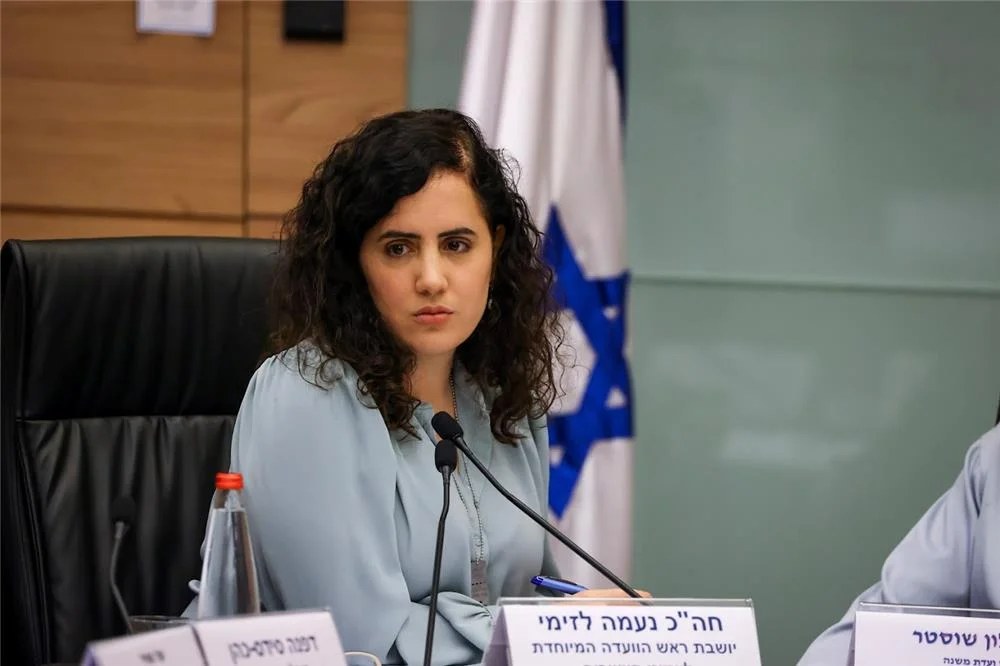
The Special committee on Young Israelis, chaired by MK Naama Lazimi (Labor), discussed on Monday the youth revolution that was initiated by slain Prime Minister Yitzhak Rabin’s government.
Committee Chair MK Lazimi (Labor) said that as prime minister, Rabin “invested in education, transportation, and employment, reduced school dropout rates, and created a real revolution in the periphery by making higher education accessible.” These actions and this vision, she said, “should guide us in creating a better Israel.”
Rami Hod, an executive director at the Berl Katznelson Center, said “We know the government can act for the benefit of the citizen, such as with the decisions regarding the National Health Insurance Law, the construction of Highway 6, the establishment of Ben Gurion Airport 2000, the [establishment] of public academic colleges in the periphery – actions that resulted in an increase in the number of students, the creation of venture capital funds that laid the groundwork for the high-tech industry, and the doubling of investments in local Arab municipalities. All of these decisions should be leading our hope.” He said that after Rabin’s assassination, the state-religious education system came up with an alternative event to mark the death of the biblical figure Rachel, and the Ministry of Education does not monitor or require any mention of Rabin’s legacy.
Ephraim Sneh, who served as health minister in Rabin’s government, said “Rabin would not make a promise unless he was certain he could keep it, and he never lied under any circumstances.” He also highlighted the importance of the National Health Insurance Law, which benefits the public, and noted that the policy at the time was social-democratic, ensuring that every citizen received optimal healthcare, especially in the periphery. Rabin, Sneh told the committee, was shocked by the situation of the Arab minority, and during his tenure, the number of clinics that were built for mothers and children in the Arab sector exceeded the number of clinics that were built for this population in all the years prior.
Hagit Ofran of Peace Now’s Settlement Watch project spoke about what she referred to as the hope the Oslo agreement gave, “unlike the current government, which is creating a never-ending war and total despair.” She said the change in Rabin’s priorities was significant in terms of investment in settlement construction. The construction moratorium in the West Bank occurred even before the Oslo agreement, and the number of new housing starts dramatically dropped, Ofran said, while also noting the change in east Jerusalem during the term of the Rabin Government.
Actor Ben Adam shared his admiration for Rabin and his hope for lasting peace, expressing his fear about the assassination and the incitement that preceded it, the “disappearance of the word ‘peace,'” and the collapse of the younger generation under the economic burden.
Micha Goldman, deputy minister of education in Rabin’s government, said he was among those who was escorting Rabin to his car before the assassination. He spoke about the extensive investment in the Galilee, Negev, and Jerusalem during Rabin’s government, as well as the narrowing of educational and infrastructure gaps, including in Judea and Samaria and the Arab and Haredi sectors.
Tal Frankentaler, Vice Chair of the Young Democrats, spoke about her hope for peace, a welfare state, public education, and affordable housing.
Dan Segal, joint manager at the Bustan (Orchard) social change initiative in Nof HaGalil, said the interaction between Jewish and Arab society in Israel occurs almost exclusively in mixed cities, and currently, there is no government policy or planning for this reality. Janan Awad-Elias, also a joint manager at the Bustan initiative, said her family moved from Nazareth to Nof HaGalil due to the lack of personal security, the need for social integration, and quality of life. She stressed the need for creating opportunities for interaction between the populations, in order to build trust.
Omer Bret Shalom, spokesperson for Dror-Israel, said the movement was active in some 100 schools to commemorate Rabin’s memory.