








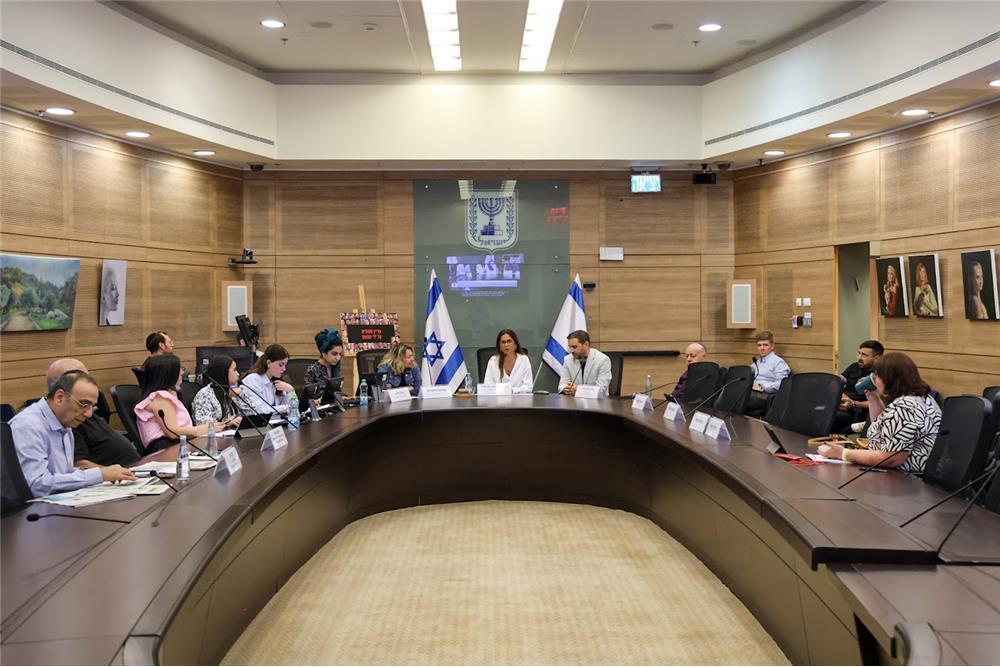
The State Control Committee convened on Wednesday for a debate on the measures taken by the state to prevent high-quality intelligence from being supplied to the enemy in wartime by civilians. During the discussion, participants pointed to many significant failures in the system that protects Israeli intelligence, which leaks to social media and endangers the lives of IDF soldiers and Israeli civilians.
Substitute Committee Chair MK Merav Ben Ari (Yesh Atid) said, “We are in a situation in which very significant information that could assist the enemy is freely available on [social] networks, and we must stop this. Issues that cannot be discussed here publicly will be discussed by a designated classified committee. After Operation Guardian of the Walls, videos were published on TikTok depicting harm to Israeli civilians. We convened together with TikTok management and dealt with the issue successfully. We need to examine how to conduct a similar dialogue with Telegram’s management in Israel regarding information leaks. There is a vacuum here that must be urgently addressed in order to [strengthen] Israel’s security. We will hold a classified debate to examine how we can prevent harm to IDF soldiers as a result of this information leakage.”
MK Ron Katz (Yesh Atid) mentioned that on Tuesday evening, in a Telegram group, it was reported that there was a severe incident in Gaza, and it was written that an explosive device was attached to a Puma (armored personnel carrier). “This caused massive panic, particularly because the unit’s name was mentioned. We [had to calm] thousands of parents of soldiers, because there is no real way to control the event, while every launch towards Israel was immediately leaked,” he said. “Israel cannot be, on the one hand, a technological power, while at the same time the enemy can just open Telegram and know everything. Locations of [missile] landings and problematic information are posted daily [on Telegram] – troop movements in Gaza, strikes on strategic sites — these are things that are not discussed in classified briefings in the Foreign Affairs and Defense Committee. I left the discussion more troubled. The repercussions of information leakage harm soldiers in the field.”
Deputy Chief IDF Censor for Strategic Affairs Ron Karnieli said, “The censor’s powers derive from emergency regulations, a censor order and High Court of Justice rulings. The censor intervenes when, in our assessment and to the best of our knowledge, the enemy may have access and conclusions that could harm state security. The censor deals with media reports. We also work with Telegram groups and take various measures.”
Government Press Office Director Nitzan Chen said, “We work opposite all the institutional media outlets, both Israeli and foreign. In the 12 days of the war, 333 journalists passed through the land crossings, which is a record number. We handle exceptions, such as revoking a press card, and they are immediately sent away, with everything that entails. For all intents and purposes, they are illegal residents. Yesterday, a Turkish reporter in Be’er Sheva violated censorship rules, and the matter was handled quickly. Today, any passerby with a smartphone can broadcast, and it is impossible to control them, except through awareness and the dissemination of information.”
Shlomit Landes, head of the Israel Police’s Investigations Division, said “Regarding civilians posting locations [of missile landings], the police are limited by the Penal Law and what enforcement we are allowed to carry out. The body responsible for offenses against state security is the Shin Bet. It is in their jurisdiction. In good faith, media bodies, officials, and ordinary people shared locations. Some locations were cleared for publication, so how can we expect a civilian to understand when it is allowed and when it is prohibited? The issue is very complex, and it is discussed regularly.”
Yossi Maimon, head of the Domestic Policy Division in the National Security Council, said “There are problems that endangered and killed many soldiers. In the event at the Golani Brigade training base – it was very easy to get there. Yesterday, the location of the incident was published, as well as the rescue operation, which took three hours. It could have ended in a worse disaster. We need to check if soldiers in battle are not being persuaded to disclose information to Telegram and other [elements].”
Rafael Hayun, an expert in intercepting enemy communications, said “During the activity of [Israeli] forces, information about the event is posted, and it reaches the enemy quite quickly. I see in real time how the forces are harmed as a result of leaked information. There is live footage of Tel Aviv – hit or miss— I see how they track these things. This is life threatening. It cannot be that every Telegram channel and WhatsApp group provides information. I see with my own eyes how forces are harmed.”