









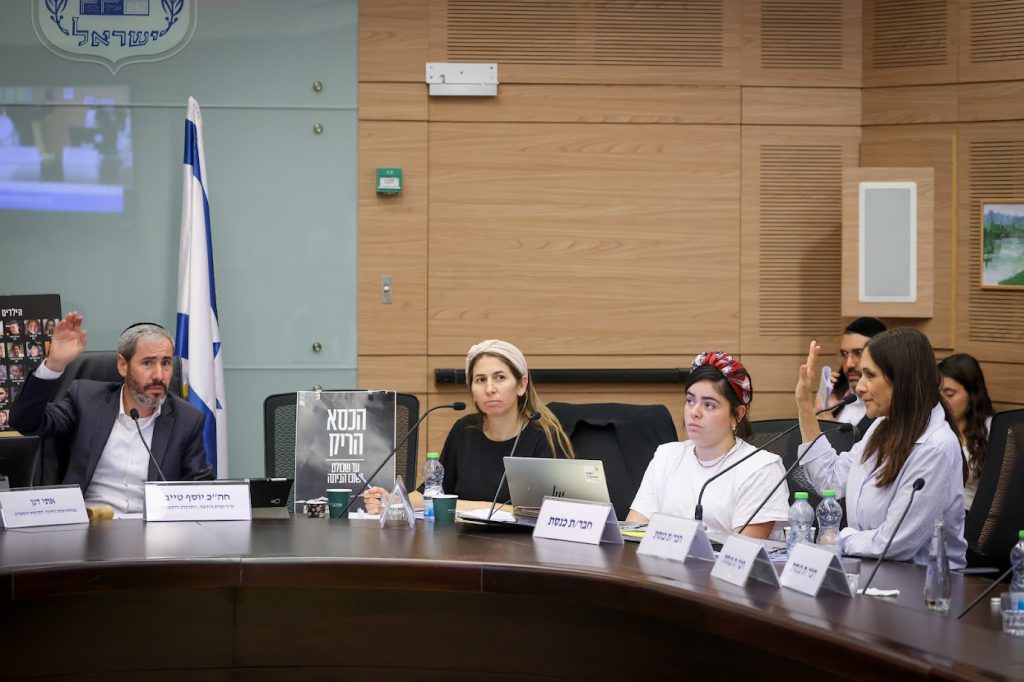
After extensive deliberations over the past year, the Education, Culture and Sports Committee, chaired by MK Yosef Taieb (Shas), voted on Monday to approve for first reading the Marking the Memory of the Massacre and Commemorating the Heroism of October 7 Bill, 2025. Representatives of the families of the hostages and families of the people murdered in the October 7 events played a significant role in the deliberations and voiced different positions on the inchoate legislation. The family members repeatedly expressed a request to have one guiding hand [for commemoration], and for them to be part of it.
The private member’s bill, which was signed by over 80 MKs, proposes that every year, on the 24th of Tishrei, a national memorial day will be marked for the massacre and the heroism of October 7, for communing with the memory of those who perished and acknowledging the heroism of the civilians and security and rescue personnel who laid down their lives to save others. On this day, a state memorial service will be held, the Knesset will hold a special debate and the national flags in public institutions and military camps will be lowered to half-mast. Educational and value-based activities will be held in educational institutions, and the media outlets will express the special character of the day in their broadcast schedules.
The bill also proposes to establish in the western Negev a memorial authority that will include a memorial site, a museum and an archive. These will be set up within four years, and the information pertaining to the October 7 events will be concentrated there, in the form of documents, videos, objects and more. The memorial authority will consists of a 13-member council, including six representatives of government ministries, and a 7-member majority of public representatives: Representatives of localities, families of hostages and bereaved families whose loved ones perished in the massacre. The mechanism for choosing the public representatives will be determined in further deliberations in the Knesset. The annual budget of the authority will be financed from the state budget, self-generated revenues, bequests, donations and grants.
The Ministerial Committee for Legislative Affairs approved a similar government bill about two weeks ago. The Education, Culture and Sports Committee sought to expedite the legislation, and for this reason intensive deliberations already commenced in September 2024. Committee Chair MK Taieb: “I hope that after the vote in first reading, the private member’s bill will be merged with the government bill that passed in the Ministerial Committee for Legislative Affairs. There is no war over credit here. In the deliberations, we tried to draw up the bill with principles that are compatible with the government bill, which will also undergo fine-tuning and changes here. We won’t reach the second and third readings without having a very broad consensus here from all sectors. We hope that by the time the bill is approved in final readings, all the hostages will return.”
A considerable share of the deliberations was dedicated to the name of the bill. MK Etty Hava Atia (Likud), one of the bill’s sponsors, wished to call it the “Memorial Day for the Massacre and Heroism.” Galia Hoshen, mother of Hadar, who was murdered at the Nova music festival: “I have difficulty with the word ‘massacre’ in the name of the bill. In addition, the Hebrew date also has to appear. We’re a Jewish state.” Yoram Yehudai, father of Ron Yehudai, who was murdered at the Nova music festival, objected to the committee’s decision to hold the memorial day on the 24th of Tishrei: “The memorial day should only be on October 7, that is the date that the whole world knows.” Committee Chair MK Taieb: “We live in a Jewish state. Just as Independence Day was set on the Hebrew date, the 5th of Iyar, the same will be done here.” However, he said that the issue would be raised for discussion again during the further deliberations ahead of the second and third readings.
Yocheved Lifshitz, who was freed from Hamas captivity after 17 days, participated in one of the committee’s meetings, and voiced opposition to the bill: “Those who should be dealing with the memorial issue are the localities that suffered severe harm, not the Knesset. First a state commission of inquiry should be formed. It was my grandson who raised the [idea] of the legislation that is on the agenda, but I am averse to this. This should be rejected out of hand, and we should wait until all the hostages return.” Committee Chair MK Taieb was moved by her words, saying, “I would like to ask your forgiveness for the fact that the State of Israel was not there that day, and for the fact that there are still hostages in Hamas captivity.” MK Taieb explained that the legislative process was lengthy, and that the bill had been signed by over 80 Members of Knesset: “It’s unthinkable that after the hostages return and the war ends, and when October 7 arrives, the State of Israel will not be prepared for that day, as a state. It’s not easy for me to deal with this complex bill, certainly not when all the hostages are not in our hands. This is not from disrespect, heaven forbid, or from a desire to distort what happened, but rather from a genuine hope that we will see our hostages soon and that we will reach the anniversary with a bill that is ready.”
Mor Shamli, whose husband Alon was murdered during their trip to Egypt on October 8, presented her painful story during the committee’s deliberations, and asked to add her husband to the legislation. She thanked the committee chair for consenting: “For two years I felt that no one saw me, and here I feel that people see me and listen to me.”